Development in Typical and Atypical Populations
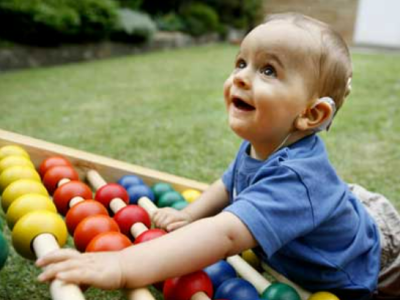
Understanding how children learn language requires studying both typical development and cases where the process unfolds under atypical conditions. Early work in the Bortfeld Lab focused on how typically developing infants recognize words in fluent speech and whether the perceptual abilities that support this process are specific to language. Building on this foundation, current research extends to children with cochlear implants, who acquire language from a substantially degraded signal. By examining how perceptual, cognitive, and social factors shape their outcomes, Dr. Bortfeld’s team seeks to identify mechanisms of neural plasticity and strategies to optimize language learning across diverse developmental contexts.
Integration of Audio and Visual Speech
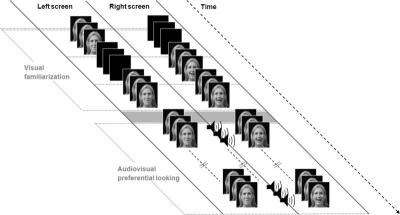
Language learning depends not only on sound but also on the visual cues provided by a speaker’s face. Infants, like adults, rely on both auditory and visual signals when perceiving speech, underscoring the critical role of multimodal input in early language development. Dr. Bortfeld’s lab employs neurophysiological and behavioral methods to examine how infants integrate audio and visual speech cues and how this integration supports subsequent language outcomes. Complementary studies in adults extend this line of inquiry, testing how mature audiovisual systems adapt to different communicative environments. Together, this work establishes how the brain combines perceptual streams across development to support robust speech and language processing.
(Figure from Baart, Vroomen, Shaw, & Bortfeld, Cognition, 2015)
Language Experience and Cognitive Processing
Heritage speakers, individuals exposed to one language at home while acquiring English as the dominant societal language, provide a critical opportunity to examine how language experience shapes the brain. Of scientific importance is understanding how patterns of input, use, and identity influence both language processing and broader cognition. Dr. Bortfeld’s lab studies heritage speaker populations in the United States using behavioral and neuroimaging methods to track how bilingual experience reorganizes neural systems. This work sheds light on the variability of language outcomes and advances knowledge of the dynamic interplay between language, experience, and cognitive development.
 Bortfeld Lab